

BaltimoreTransitFacts.org
Fact-based news, analysis and information
Why Public Transit Matters
As a region’s public transit goes, so goes the ability of its citizens to access opportunities to build better lives for themselves, their families and the broader community.
By connecting residents to schools and jobs, workers to employers, and businesses to customers, public transportation expands economic opportunity and strengthens regional competitiveness.
Because public transit is highly efficient, it also reduces traffic congestion, lowers transportation costs, cuts greenhouse gas emissions and air pollution, and makes more productive use of public infrastructure.
How Baltimore's Failing Transportation System Costs Us All
In comparison to 19 other metropolitan regions of similar size, Baltimore's transportation system is among the worst in connecting residents with education and economic opportunities. In holding back individual advancement, it holds back the region's collective prosperity.
Tens of thousands of middle and high school students in Baltimore City, the only municipality in Maryland without yellow bus service, rely on MTA buses, Metro and Light Rail to get to school. However, they endure lengthy trips that often require multiple transfers, increasing tardiness and limiting access to higher-performing schools.
According to the 2026 Transportation Report Card, Baltimore's transportation system receives an overall grade of D. A typical resident can reach just 7.5% of the region's jobs within an hour by transit, earning an F for job access by transit. The region also earns an F for disconnected communities, with 21% of workers commuting 45 minutes or more and the longest average commute among its peer regions.
D
Overall Grade
F
Job Access by Transit
F
Disconnected Communities
Baltimore Transit By The Numbers
38,716
Baltimore City students who rely on public transit to attend school
114,926
Baltimore-area households without access to a car
90%
Baltimore-area bus riders who are low-income
29%
Increase in jobs located near metro stations
$5 Billion
Long-term economic value generated per $1 billion invested in transit
41,400
Jobs created or sustained per $1 billion invested in transit
F
Grade for Job Access by Transit
F
Grade for Disconnected Communities
Transit News & Updates

September 30, 2026
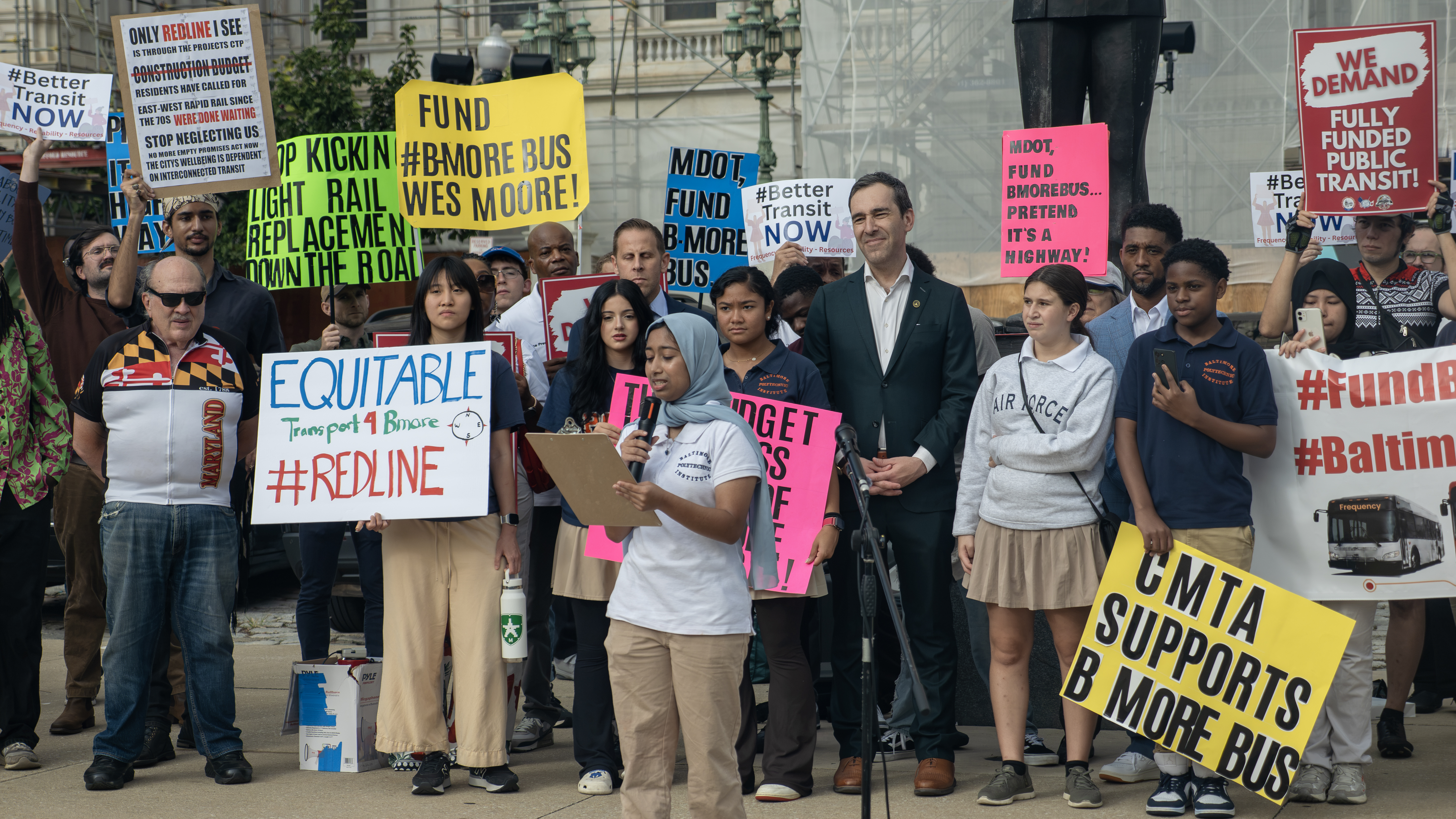
Baltimore Students Blame Elected Leaders for Unreliable Transit to School
September 28, 2026
Maryland Must Not Shortchange Public Transit